Marketing Agency vs. Fractional CMO: What’s the Difference and Which One Do You Actually Need?

The Question Every Growing Business Eventually Asks

You’re spending money on marketing. Maybe you have an agency. Maybe you’ve had a few. The results have been uneven, some wins, a lot of spend that’s hard to connect to actual revenue, and a growing sense that no one is really coordinating the bigger picture.

So the question comes up: should I hire a marketing agency, bring in a fractional CMO, or do both?

The answer depends on what’s actually broken in your marketing system, not on which option sounds more sophisticated. This guide breaks it down honestly so you can make the right call for where your business actually is right now.

What a Marketing Agency Does (And What It Doesn’t)

A marketing agency provides execution services, the tactics that put your brand in front of buyers and move them toward a decision. That includes:

  • Paid media (Google Ads, Meta Ads, programmatic)
  • SEO and content marketing
  • Web design and development
  • Social media management
  • Email campaigns and automation
  • Creative and brand production

A good agency is excellent at executing within a defined strategy. The limitation is the word “within.” Most agencies are not in the business of setting the strategy, aligning it with your operations, or holding themselves accountable to revenue outcomes. They’re in the business of delivering the channel output you hired them for.

That’s not a criticism, it’s a structural reality. An agency managing ten or twenty clients simultaneously can’t embed deeply enough into each business to own the strategic layer. So they don’t. They execute. You set the direction. Or nobody does.

What a Fractional CMO Does (And What It Doesn’t)

A fractional CMO provides senior marketing leadership on a part-time or contract basis. The job is strategy, alignment, and accountability, not day-to-day execution.

A fractional CMO:

  • Defines the overall marketing strategy and connects it to business goals.
  • Sets channel priorities based on where your buyers actually are and what your margins can support.
  • Coordinates and holds vendors or agencies accountable to outcomes, not just activity.
  • Builds or develops your internal marketing team when the time is right.
  • Reports to ownership on what’s working, what isn’t, and what’s next, in revenue terms.

The limitation is the inverse of an agency’s: a fractional CMO is a strategist, not a producer. You still need execution resources, an agency, an in-house team, or a combination of both. The fractional CMO tells everyone what to build and holds them accountable for building it.

The Real Difference: Who Owns the Strategy?

The core question is this: Does your business have a real marketing strategy, or does it have a collection of marketing tactics?

Most businesses have tactics. They’re running ads, posting on social, and paying someone to do SEO. What they don’t have is a coherent strategy that connects those channels, prioritizes spend based on actual buyer behavior, and ties activity to revenue in a way that’s visible to the people making decisions.

That gap is what a fractional CMO fills.

When to Choose a Marketing Agency

Hire an agency when:

  • You have a defined strategy and need disciplined, consistent execution across one or more channels.
  • You need specialists in a specific channel, paid media, SEO, content, that you can’t build in-house cost-effectively.
  • You’re launching a specific campaign with a clear objective, audience, and timeline.
  • Your business is early-stage and you need marketing output before you can afford strategic leadership.

The key word is “defined.” An agency without a strategy to execute is expensive guesswork.

When to Choose a Fractional CMO

Hire a fractional CMO when:

  • Marketing spend is growing but it’s hard to connect it to revenue at the business level.
  • You have vendors or an internal team but no one is coordinating them into a coherent system.
  • You’re making major growth decisions, entering new markets, launching new products, repositioning the brand, without senior marketing input at the table.
  • You need marketing to report to the business at an executive level, not just at the channel level.
  • You’ve been through two or three agencies and the results still haven’t materialized.

That last point deserves emphasis. If you’ve changed agencies and the problem keeps following you, the issue is almost never the agency. It’s the absence of a strategy for the agency to execute, and the absence of someone qualified to build that strategy and hold everyone accountable to it.

Can You Have Both? (Short Answer: Often Yes)

For mid-size businesses, the right answer is frequently both, working together. A fractional CMO sets the strategy and manages the agency relationships, holding everyone accountable to business outcomes. The agency executes within that framework. The system works because someone with real skin in the game is watching the whole picture, not just their slice of it.

At Curiosity, this is exactly how we operate for many of our clients. We provide fractional CMO-level strategy and embed it into an agency model that handles execution, one team, one accountability layer, one system that connects marketing activity to the revenue outcomes that actually matter.

Quick Wins Before You Make the Decision

  • Audit how your marketing activity is currently being reported. Is it channel metrics or business outcomes?
  • Ask your current agency what they’d do differently if they owned the strategy. The answer will tell you a lot.
  • Map your marketing spend to revenue by channel. If you can’t do it, that’s the first sign you need a fractional CMO.
  • Check whether your vendors know what each other is doing. If the answer is no, you’re paying for activity that isn’t compounding.

How We Help

If you’re evaluating whether you need strategic leadership, better execution, or both, the fastest way to figure it out is a real conversation. Book a free strategy call and we’ll map your current marketing setup against where you’re trying to go. No pitch, no obligation. Just an honest read on what’s actually missing and what it would take to fix it.

AI in Marketing: How We Use It and What It Means for Your Business

Clients Keep Asking About AI. We’re Glad They Are.

The question comes up in almost every strategy conversation now: what does AI mean for our marketing?

It’s the right question to ask. AI is changing what’s possible faster than most tools ever have, and business owners who are paying attention are right to want to understand how it affects their investment, their content, and the agency they trust with their brand.

Here’s the honest answer: we’re already using AI in thoughtful ways across our work. It helps us move faster, explore more creative directions, and bring more depth to research and strategy. And it does not replace the expertise, judgment, and careful attention every client deserves.

  • AI is a tool. How well it works depends entirely on who’s using it and why.
  • Strategy, accountability, and brand judgment still require human expertise.
  • Our use of AI is deliberate, not default.

What AI Actually Does Well in Marketing (And What It Doesn’t)

Before we explain how we use AI, it’s worth being direct about what the technology is and isn’t good at, because a lot of the hype gets this wrong in both directions.

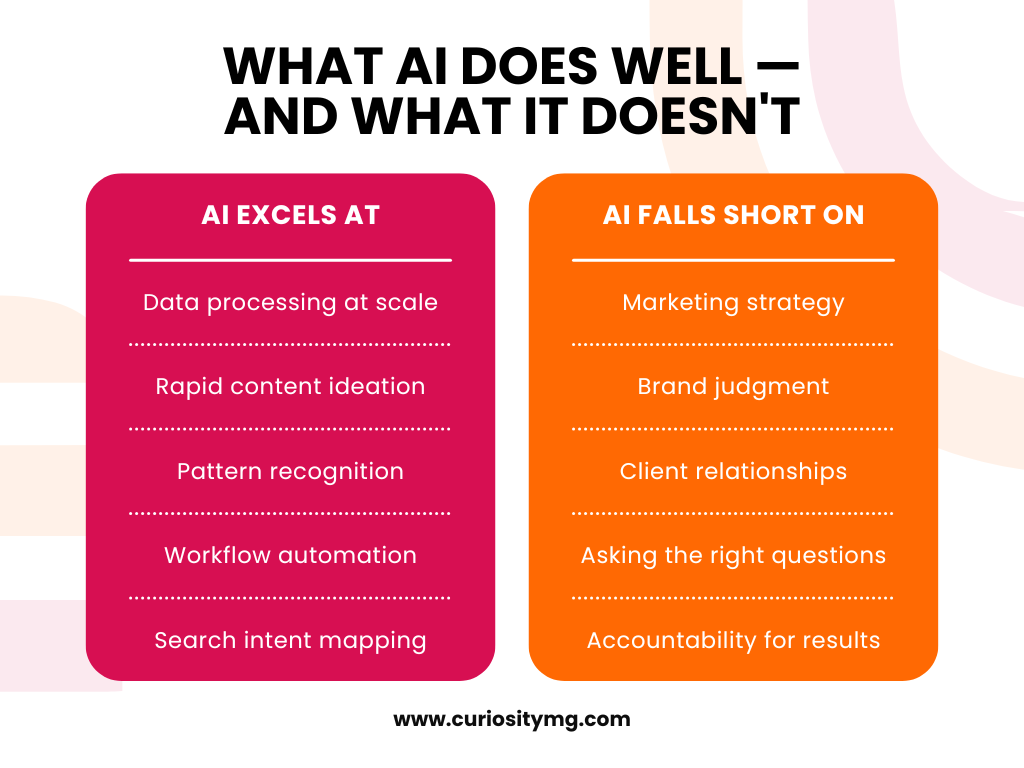
AI is genuinely strong at processing information at scale, generating options quickly, identifying patterns across large data sets, and accelerating repetitive tasks. These are real capabilities that make real work faster when applied correctly.

What AI doesn’t do well: make strategic decisions, understand your specific market dynamics, build relationships, or know what makes your business meaningfully different from a competitor. Those things require context, judgment, and experience that no model has about your business.

The mistake most agencies will make, and many already are, is treating AI output as finished work. The brands that will win with AI are the ones using it to sharpen their thinking, not replace it.

How We Use AI Inside Our Work

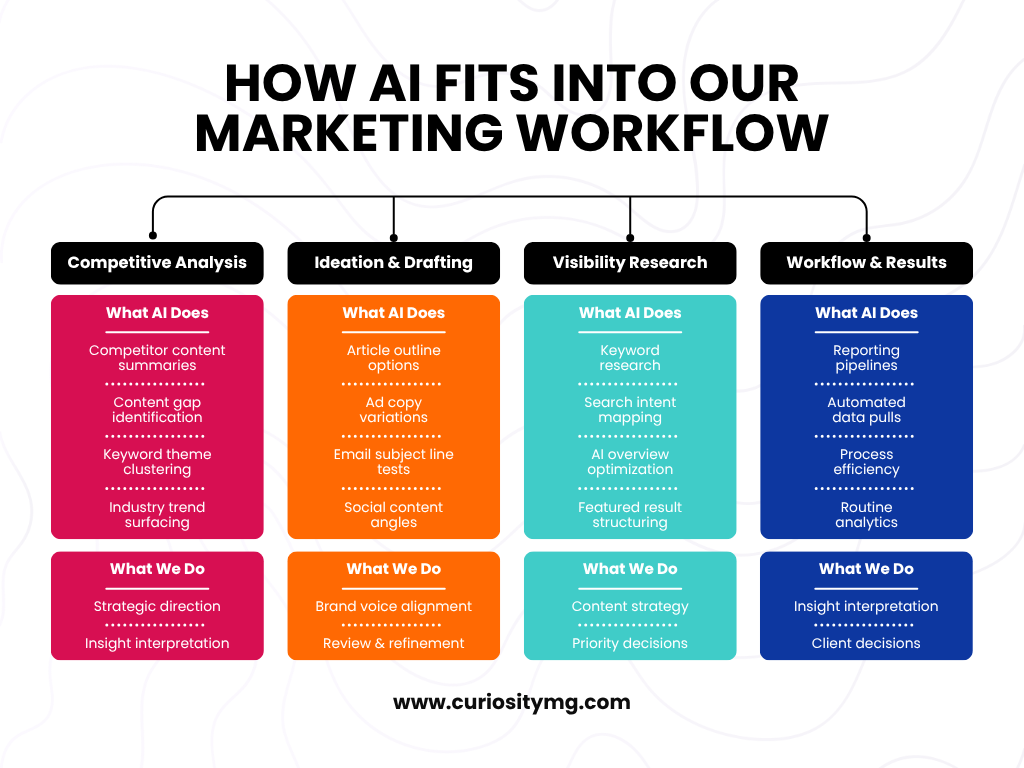
Research and competitive analysis

We use AI tools to accelerate the early stages of research: summarizing competitor content, identifying content gaps, clustering keyword themes, and surfacing trends across industries. Work that used to take several hours to compile now takes a fraction of the time, which means we spend more of the engagement on analysis and strategy rather than data gathering.

Content ideation and drafting

AI helps us generate more options, faster. When we’re developing article outlines, ad copy variations, email subject line tests, or social content angles, AI gives us a wider starting field to work from. Everything that reaches a client has been reviewed, rewritten where needed, and aligned to their brand voice by our team. AI creates the raw material. We shape it into something that actually sounds like you.

SEO and visibility research

AI-powered tools have changed how we approach keyword research, search intent mapping, and AI search visibility. Understanding how AI overviews pull content, which query types trigger featured results, and how to structure content for both traditional and AI-driven search results is now part of every SEO engagement we run.

Workflow and reporting efficiency

Behind the scenes, AI helps us build faster reporting pipelines, automate routine data pulls, and spend less time on process and more time on the decisions that actually move client results. The output you see, the strategy, the recommendations, the reporting, reflects more thinking, not less, because we’re not spending half the time on manual work.

What AI Will Never Replace in Our Work

This is the part that matters most, and it’s where we want to be completely clear.

Your strategy

AI does not set your marketing strategy. It cannot understand your growth goals, your competitive position, your sales team’s constraints, or the nuances of your market the way an embedded partner does. Strategy requires asking the right questions before producing any output, and that’s a human function.

Brand judgment

AI can write in a style. It cannot make the call on whether a piece of content sounds like your brand, serves your buyer, or earns the trust you’ve spent years building. That judgment belongs to people who know your business.

Client relationships

The work we do is built on communication, transparency, and accountability. AI doesn’t attend strategy calls. It doesn’t notice when a campaign result needs a real conversation. It doesn’t push back when a client’s instinct conflicts with what the data says. Those conversations are where the real value lives, and they require a person who cares about your outcomes.

Accountability for results

At the end of the month, results are either there or they aren’t. AI doesn’t own that. We do.

Why This Matters for Your Marketing Budget

If you’re evaluating agencies right now, ask any one of them how they’re using AI. The answers will tell you a lot.

An agency using AI to cut corners will produce more content faster, charge the same rate, and deliver less thinking. You’ll feel it in the work before you see it in the numbers.

An agency using AI well will produce more options, sharper research, and faster iteration, without sacrificing the strategy and judgment that actually drive results. That’s the version that compounds over time.

We fall into the second category. AI makes us faster and broader in what we can explore. The standard for what reaches a client hasn’t changed.

Quick Answers to What Clients Are Actually Asking

  • Will AI write all my content?
    No. AI is part of the process. Everything client-facing is reviewed, refined, and aligned to your brand by our team before it goes anywhere.
  • Is AI going to make marketing cheaper?
    Not in the way most people expect. It can make some production faster, but strategy, expertise, and accountability still require real investment.
  • Should I be using AI tools myself?
    Possibly, depending on your team and your goals. We can help you figure out where AI fits in your internal workflow and where it creates more risk than value.
  • Is AI going to hurt my SEO?
    Only if it’s used to produce low-quality, undifferentiated content at scale. Used well, with a clear content strategy, it can strengthen your SEO significantly.

How We Help

If you want to understand exactly how we’re applying AI to your marketing, or how it might change what’s possible for your business, that’s a conversation worth having. We’re not using AI to automate our thinking. We’re using it to do more of the work that matters. Book a free strategy call and we’ll show you what that looks like in practice.

Video Marketing Services: What Actually Drives Results (And What’s a Waste of Budget)

What Are Video Marketing Services? (Plain-English Definition)

Video marketing services cover the strategy, production, and distribution of video content designed to move buyers through your funnel, from awareness to consideration to decision. That includes everything from short-form social content and YouTube ads to testimonial videos, explainer content, and full brand campaigns.

Done well, video is the highest-converting content format in most markets. Done wrong, it’s the most expensive way to produce content nobody watches.

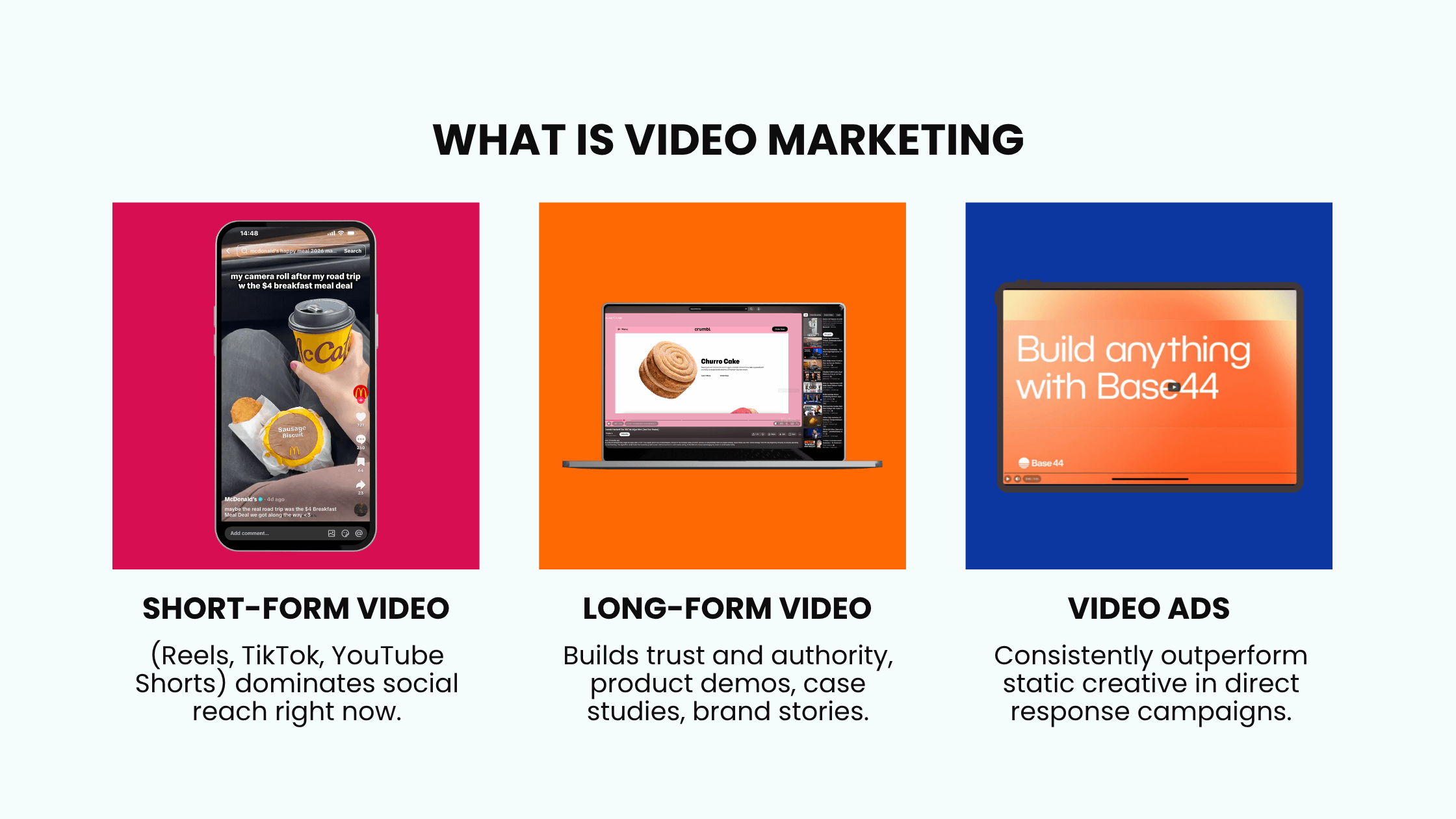
  • Short-form video (Reels, TikTok, YouTube Shorts) dominates social reach right now.
  • Long-form video builds trust and authority, product demos, case studies, brand stories.
  • Video ads consistently outperform static creative in direct response campaigns when paired with the right offer and a landing page that’s built to convert.

Why Video Marketing Belongs in Your Growth Strategy Right Now

Video isn’t a content trend. It’s a behavior shift that’s already happened. Your buyers are spending more time watching video than reading anything else online, and the brands showing up in that format are the ones building familiarity, trust, and recall at scale.

Here’s what the data consistently shows:

  • Higher retention: Video content is processed faster and remembered longer than text.
  • Better conversion rates: Product and service pages with video convert at significantly higher rates than those without.
  • Stronger ad performance: Video ads generate more brand recall and purchase intent than static alternatives at comparable spend.
  • Compounding organic reach: Well-produced YouTube content continues to generate views and leads for years after publishing.

The question isn’t whether video should be part of your strategy. It’s whether you’re using it in the right places, for the right audience, with the right message.

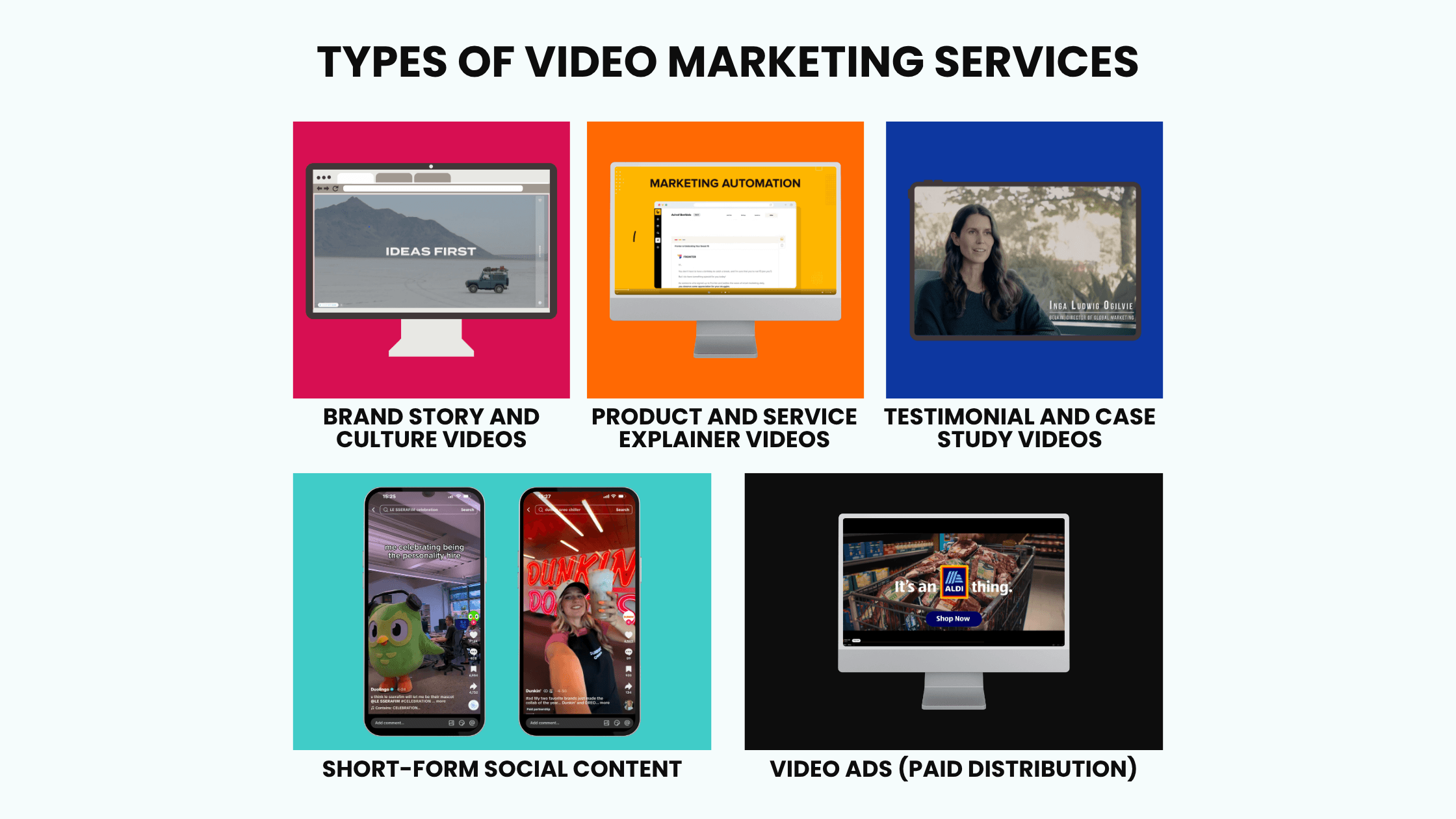
Types of Video Marketing Services (And When to Use Each)

Brand story and culture videos

Introduce who you are, why you exist, and what makes your approach different. Best used on your homepage, About page, and in top-of-funnel social content. These build trust before a buyer ever reaches your sales conversation, and they do the work that no amount of copy can replicate.

Product and service explainer videos

Show exactly what you do and how it works. Especially powerful for services that are hard to explain in text, complex B2B offerings, technical services, or anything with a learning curve. These live on service pages and shorten the sales cycle by answering the questions buyers have before they ask them.

Testimonial and case study videos

Real clients talking about real results. This is the most trusted format in any content mix, and the most underused. A single well-produced testimonial video does more for your sales page than five paragraphs of copy about how great you are. These belong on landing pages, in email nurture sequences, and in retargeting campaigns.

Short-form social content

Fifteen to ninety seconds, built for the scroll. Not a commercial, a conversation. These work best when they answer one specific question or make one specific point. Tips, quick wins, myth-busting, and behind-the-scenes content that builds personality and keeps your brand present in your buyer’s feed between purchases.

Video ads (paid distribution)

Pre-roll YouTube ads, Meta video ads, connected TV. The format is video, but the strategy is direct response, clear offer, clear call to action, specific audience, measurable outcome. Video ads work when everything else is working: the offer, the landing page, the follow-up sequence.

What to Look for in a Video Marketing Partner

Not every agency that produces video understands marketing. And not every marketing agency can produce video that actually performs. Here’s an honest filter before you hire anyone:

  • Strategy first, production second. If a vendor leads with cameras and editing instead of audience and objective, the output will look good and perform poorly.
  • Distribution is half the job. A great video sitting on a YouTube channel with no views is a sunk cost. Ask how they plan to get it in front of your actual buyers, before you sign anything.
  • Clear metrics before you start. Define what “working” looks like, view-through rate, lead volume, cost per acquisition, before a single frame is shot.
  • They understand your audience. Regional businesses on the Gulf Coast have buyers who respond to authenticity over production value. A vendor who only produces polished corporate content won’t connect here.

How We Approach Video Marketing for Our Clients

We don’t treat video as a standalone deliverable. We build it into your broader marketing system so it does real work at every stage of the funnel.

Every video project starts with the same question: where does this buyer need to go, and what does video do better than any other format to get them there?

From there, we match the format to the objective, the distribution plan to the audience, and the metrics to business outcomes. Production quality matters, but what matters more is that the right person watches the right video at the right moment in their decision process.

Quick Wins for Video Marketing Right Now

  • Add a 60-second explainer video to your homepage. If your bounce rate is high, this is often the fastest conversion fix available.
  • Repurpose your best-performing blog content into short-form social videos. One solid post can become five pieces of video content with minimal production effort.
  • Record a client testimonial the next time you have a great customer interaction, even on a phone. Authentic beats polished every time.
  • Run a 15-second YouTube pre-roll ad to your highest-intent landing page visitors. Low spend, high relevance, measurable outcome.

How We Help

If you’re ready to add video to your marketing system, or get more out of the video you’re already producing, we can help you build a distribution-first strategy that ties production to real outcomes. Start with a free strategy call and we’ll tell you exactly what kind of video content would move the needle fastest for your business and your audience.

Marketing Agency in Panama City, FL: Curiosity Marketing Group

What to Look for in a Marketing Agency in Panama City, FL

Panama City has no shortage of agencies claiming they’ll grow your business online. Most will show you a portfolio, quote a monthly retainer, and promise results that never quite materialize in a way you can measure.

The right agency isn’t the one with the nicest website, it’s the one that understands your market, speaks plainly about what they’ll actually do, and holds themselves accountable to outcomes you care about.

Here’s what separates the agencies worth hiring from the ones worth avoiding:

  • They define results before they start. Vague promises like “increase your online presence” are cover for agencies that have no intention of being held accountable.
  • They speak your language. The right agency for a Panama City healthcare practice looks different than one for a local restaurant. Industry context matters.
  • They show you the work, not just the reports. Monthly decks full of impressions aren’t results. Ask what actually changed, and why.
  • They tell you what isn’t working. The most valuable thing a marketing partner can do is name the problem clearly, even when it’s uncomfortable.

Why Local Market Knowledge Changes Everything

PANAMA CITY, FL – FEBRUARY 2016: Panama City Beach Pier entrance sign with cars traffic at sunset

Digital marketing works differently in Panama City than it does in Miami, Atlanta, or Dallas. The buyer behavior, competitive landscape, and local search dynamics here require a different approach, one that a national agency running you through a template won’t get right.

We’ve worked with businesses across Panama City Beach, Lynn Haven, Callaway, and the broader Bay County area long enough to know what actually moves the needle locally:

  • Google Business Profile optimization is often more valuable than a paid campaign for local service businesses, especially in a market where buyers trust local proof over polished ads.
  • Seasonal traffic patterns matter. Businesses here see dramatic swings that most agency playbooks don’t account for. A strategy built for July will underperform in January if nobody planned for it.
  • Trust is built differently in smaller markets. Word of mouth and visible community involvement carry more weight here than almost anywhere else.
  • Local SEO is about specificity. Ranking for “marketing agency” nationally is irrelevant. Ranking for the specific services your buyers are searching for in this market is the game.

What a Marketing Agency in Panama City Should Actually Do For You

Build a digital presence that generates leads, not just traffic

Traffic without conversion is a vanity metric. Every channel, SEO, paid ads, social, email, should bring the right buyer to the right page at the right moment and give them a clear reason to act. If the agency can’t explain what happens after the click, they’re only doing half the job.

Connect your systems so nothing falls through the cracks

Most businesses in this market have three or four disconnected tools that don’t talk to each other. CRM not connected to the website. Lead forms going to an inbox nobody checks. Ads driving traffic to a page that’s never been optimized for conversion. The gap between marketing activity and revenue almost always lives in those disconnects.

Report in a way that builds trust, not confusion

A good agency makes it easy to understand what’s working, what isn’t, and what’s next. Monthly reporting should take you five minutes to read and give you something you can act on. If you’re getting a deck full of charts that don’t connect to your pipeline, you’re not getting real reporting, you’re getting cover.

Services We Offer Panama City Businesses

  • Web design & development: Conversion-focused sites built for how your buyers actually behave, not just how they look on a desktop at full resolution.
  • Local & national SEO: Keyword strategy, content infrastructure, and technical SEO that compounds over time and doesn’t disappear when an algorithm changes.
  • Google Ads & Meta Ads: Paid campaigns with clear cost-per-lead targets and transparent spend reporting. No black-box dashboards.
  • Social media management: Strategy-aligned content for the platforms where your buyers spend time, not every platform at once.
  • Email marketing: Automation and campaigns that keep warm leads moving toward a decision, not just an open rate stat.
  • ADA compliance: Accessibility audits and remediation for Florida businesses with real legal exposure.
  • CRM integration: The right system, connected properly, so your follow-up actually happens.
  • Analytics & ROI reporting: Every metric tied to a business outcome. No vanity dashboards.
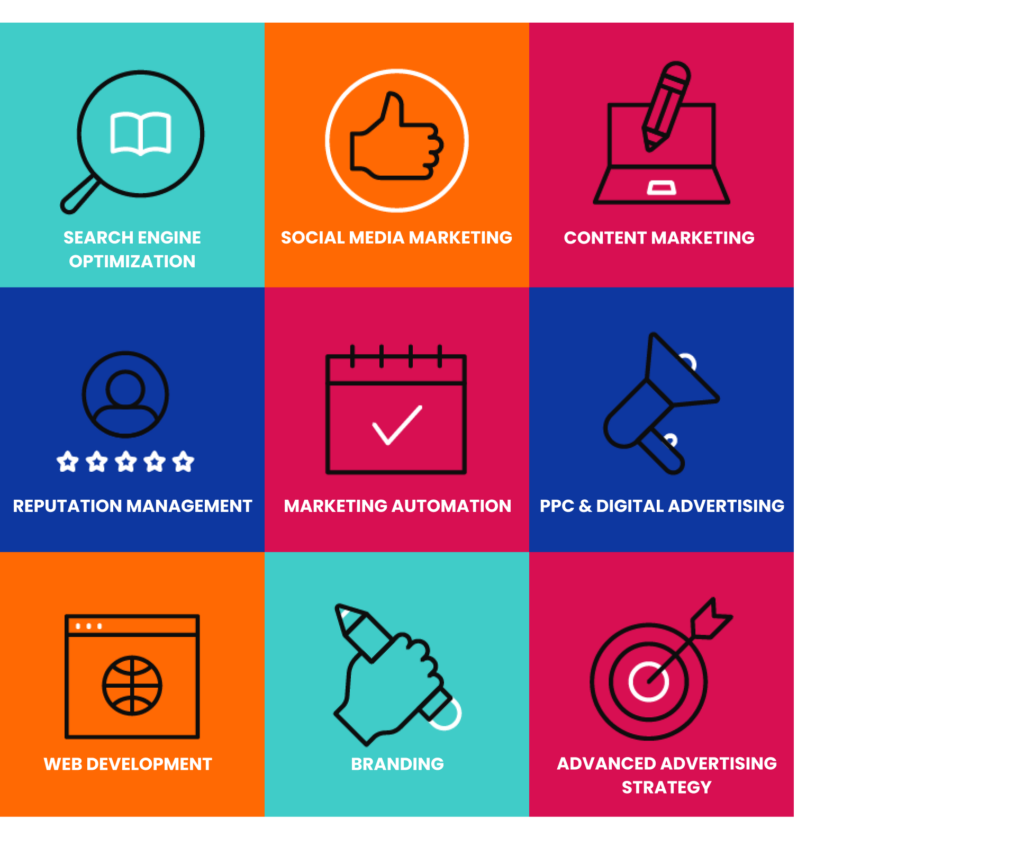
  • Fractional CMO services: Full marketing department strategy and execution, without the full-time hire cost.

Industries We Serve in Panama City

We’ve built marketing systems for businesses across Bay County and the Gulf Coast in:

  • Healthcare and medical practices
  • Construction and home services
  • Automotive dealerships and service centers
  • Tourism, hospitality, and local attractions
  • Professional services, legal, financial, consulting
  • Associations and nonprofits
  • E-commerce and direct-to-consumer brands

Quick Wins We Look for in Every New Panama City Engagement

  • Is your Google Business Profile fully optimized, categories, photos, services, Q&A, weekly posts?
  • Is there a clear path from your homepage to a phone call or form submission in three clicks or less?
  • Are your highest-traffic pages actually designed to convert, or do they just explain what you do?
  • Are your review velocity and response rate strong enough to support local rankings?
  • Is your ad spend going to audiences that match your actual buyer, or audiences that are just large?

If the answer to more than two of those is “I’m not sure,” there’s budget being left on the table right now.

How We Help

If you’re looking for a marketing agency in Panama City, FL that will tell you the truth about your current digital presence, what’s working, what’s broken, and exactly what it would take to fix it, start here. Book a free strategy call and we’ll walk through your site, your rankings, your ad account, and your lead flow. No pitch. Just a real conversation with someone who knows this market.

Fractional CMO Panama City: What It Is, What It Costs, and Who It’s Right For

What Is a Fractional CMO? (The Plain-English Version)

A fractional CMO, Chief Marketing Officer, is a senior marketing executive who works with your business on a part-time or contract basis instead of as a full-time employee. You get the strategy, leadership, and execution oversight of a seasoned marketing director without the annual salary, benefits package, and recruiting costs that come with hiring one full-time.

For most small and mid-size businesses in Panama City and across the Gulf Coast, the real choice isn’t between a fractional CMO and a full-time CMO. It’s between a fractional CMO and no real marketing leadership at all.

  • Senior-level strategy and execution alignment under one accountable point of contact.
  • Embedded into your team, not advising from the outside or pitching from a conference room.
  • Scales with your business; you pay for what you actually need, not a full salary for partial use.

What a Fractional CMO Actually Does (Day to Day)

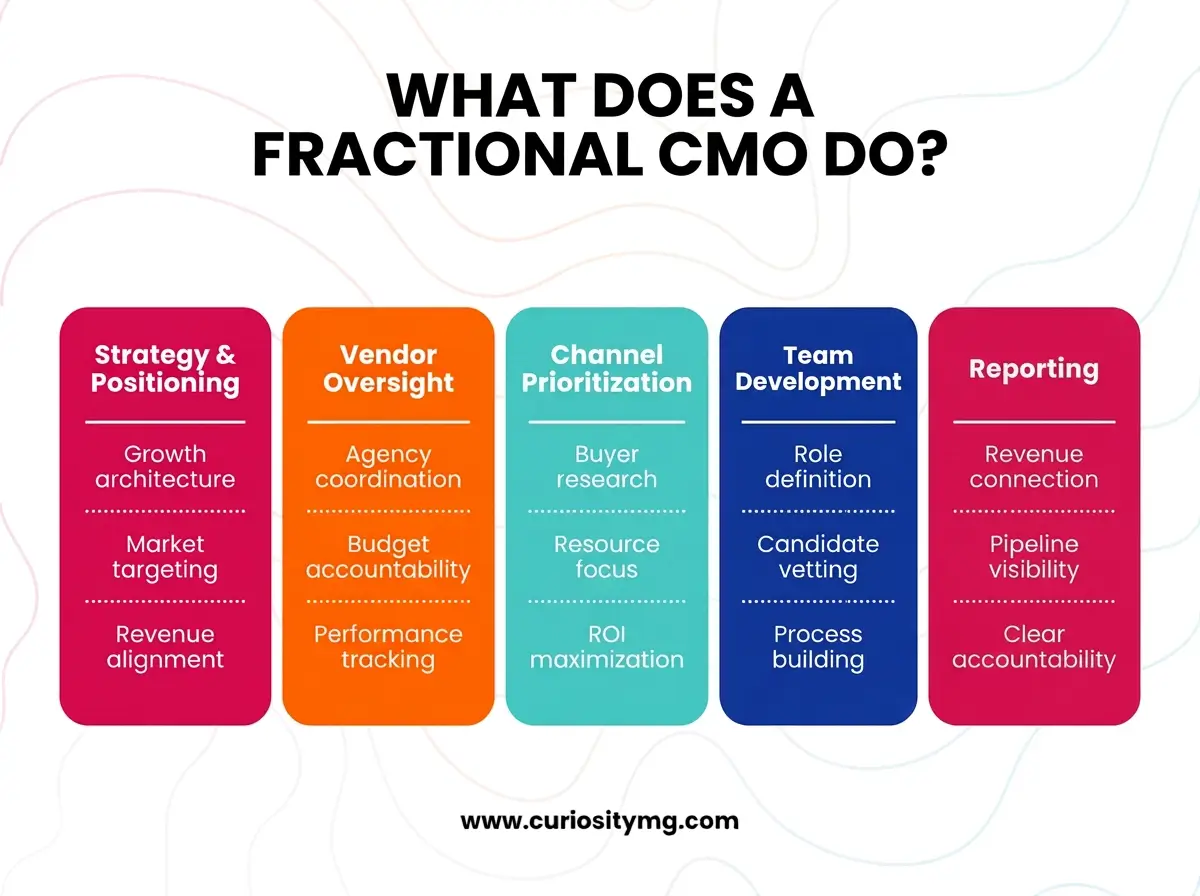
This is where most explanations fall short. A fractional CMO isn’t someone who shows up to a quarterly strategy session and sends you a deck. Done right, it’s an embedded engagement that touches the real operational decisions your business makes about growth.

Strategy and positioning

Defining where you’re competing, who you’re targeting, what message cuts through in your specific market, and how marketing connects to your actual revenue goals. Not a brand exercise, a growth architecture built around where your buyers are and how they make decisions.

Vendor and agency oversight

If you have existing marketing partners, a web developer, an SEO agency, a paid media team, a fractional CMO coordinates and holds them accountable to outcomes. Most businesses waste significant budgets on vendors operating in silos with no one managing the full system.

Channel prioritization

Not every business needs every channel. A fractional CMO identifies where your buyers actually are and concentrates resources there, instead of spreading budget thin across ten tactics that none of them can generate enough traction to justify.

Hiring and team development

If you’re building an internal marketing team, a fractional CMO defines the roles, vets the candidates, and develops the processes that make the team effective. Most in-house marketing hires fail because there’s no clear strategy for them to execute, and no one qualified to build that strategy around them.

Reporting and accountability

Monthly or biweekly reviews that connect marketing activity to pipeline and revenue. Boards, ownership groups, and investors get a clear picture of what’s working, what isn’t, and what’s next, in language that ties to the business, not just the channel.

What Does a Fractional CMO Cost in Panama City?

Fractional CMO engagements typically range from $3,000 to $10,000 per month depending on scope, hours, and complexity. For most businesses in this market, the right engagement falls somewhere between $4,000 and $7,000 per month, which still represents a fraction of the fully-loaded cost of a full-time CMO hire when you factor in salary, benefits, equity, and the months spent recruiting.

More importantly, a good fractional CMO pays for itself.

If a $5,000/month engagement generates $50,000 in additional attributable revenue, the math is obvious. The question isn’t whether you can afford fractional CMO services. It’s whether you can afford to keep making major marketing decisions without senior-level strategic input guiding them.

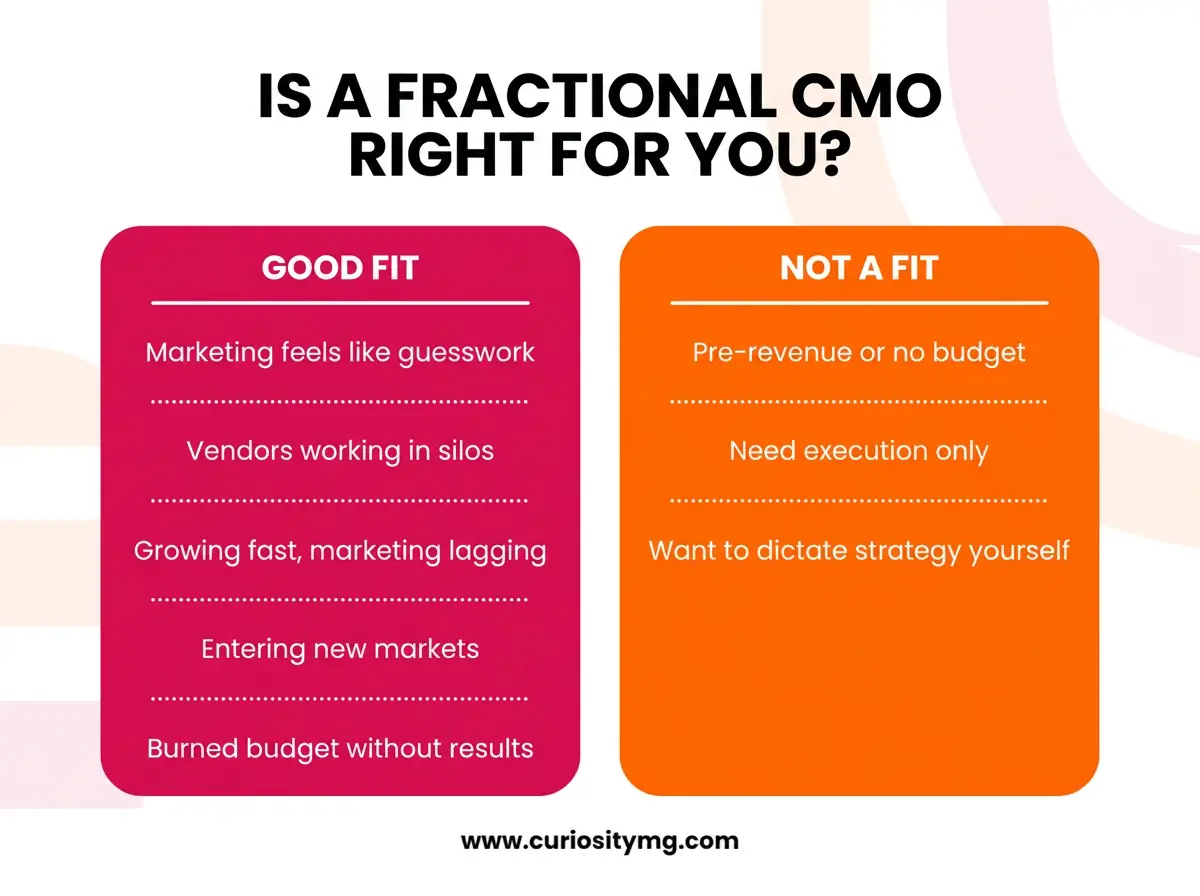
Is a Fractional CMO Right for Your Business? (Honest Filter)

Not every business needs one. Here’s a straightforward way to tell.

You’re a good fit if:

  • Your business is generating revenue but marketing feels like guesswork, activity without direction.
  • You have marketing vendors or an internal team but no one coordinating them into a coherent strategy.
  • You’re growing fast and need marketing to scale alongside operations rather than lag behind them.
  • You’re entering a new market, launching a new product, or repositioning the brand and need strategic leadership to drive it.
  • You’ve burned budget on agencies that didn’t produce results and aren’t sure what should be different.

You’re probably not a good fit if:

  • Your business is pre-revenue or too early to have a real marketing budget to direct.
  • You need execution only, content, design, ads, with no need for a strategic layer above it.
  • You want to dictate marketing strategy rather than partner with someone qualified to build it.

Why No One in Panama City Is Talking About This

Most marketing agencies in this market sell campaigns, not strategy. There’s a reason for that: campaigns are easier to scope, easier to sell, and easier to report on at the channel level. You can show clicks. You can show impressions. You can show a follower count that went up.

The fractional CMO model is harder to sell because it requires the agency to accept accountability for business outcomes, not just marketing outputs. That’s a conversation most local agencies actively avoid, because it means your results become their responsibility.

We built Curiosity around that conversation. Strategy, execution, and accountability in one engagement, because that’s the only version of marketing partnership that produces consistent growth.

How We Help

If you’re a business owner or operator in Panama City or across the Gulf Coast who’s ready to stop guessing at marketing strategy and start building one, the conversation starts here. Book a free strategy call, we’ll look at your current marketing setup, tell you honestly whether a fractional CMO engagement makes sense for where you are, and walk you through exactly what it would look like if you moved forward.

How Great Healthcare Website Design Builds Trust Before Patients Walk In

First Impressions Matter in Healthcare

For most patients, the first visit happens online, not in your waiting room. When someone searches for care, your website becomes the first handshake, setting the tone for how trustworthy and professional your practice feels.

A clean, easy-to-navigate site shows that your team values organization and attention to detail. It helps visitors feel comfortable and confident that they’re in the right place. On the other hand, cluttered layouts or outdated designs can create doubt before a patient ever picks up the phone.

Patients aren’t looking for flash; they’re looking for clarity and reassurance. A modern design with simple navigation and clear calls to action helps them find answers quickly and builds trust from the very first click.

What Every Great Healthcare Website Gets Right

When a healthcare website works, patients notice, not because it’s flashy, but because it just feels easy. The best medical sites share a few simple traits: they’re easy to use, look professional, and make patients feel comfortable and informed from the moment they arrive.

It’s Simple to Navigate

A great website guides visitors where they need to go without frustration. Clear menus, quick appointment buttons, and simple contact options make it easy for patients to take the next step. Mobile-friendly design is just as important since many visitors will find you on their phones. 

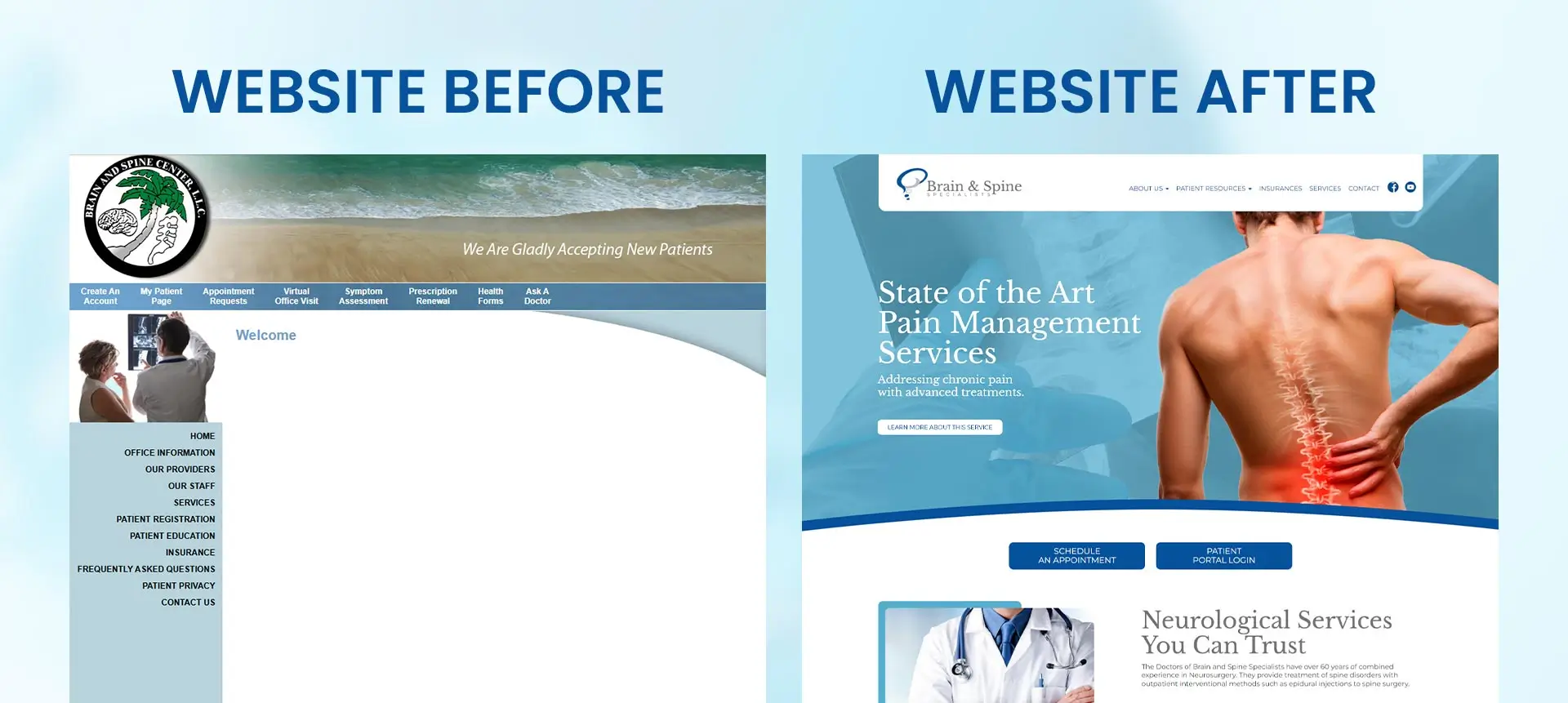
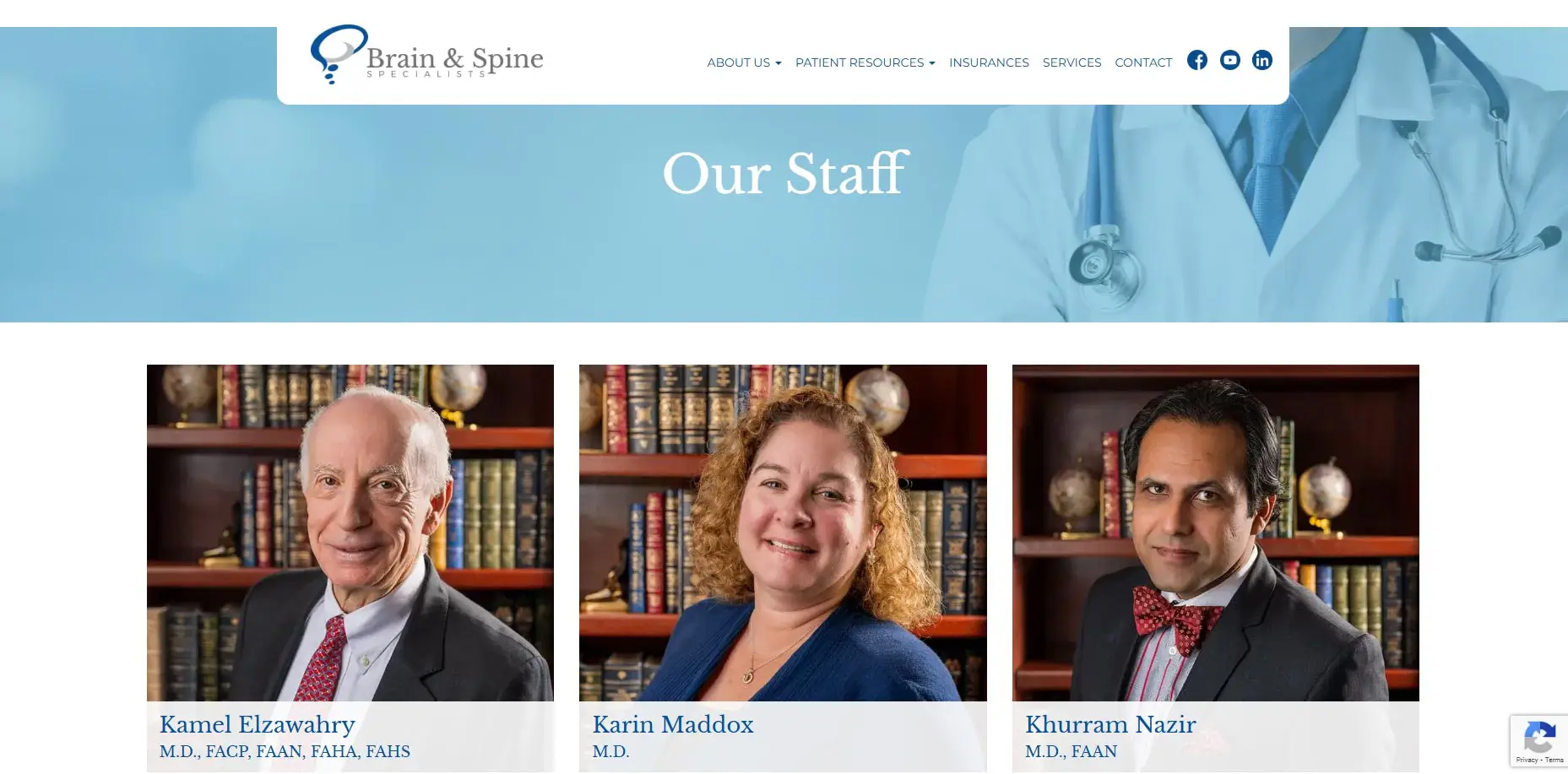
Websites like Brain & Spine and Gulf Coast Podiatry show how simple layouts and clear calls to action can make all the difference.

It Looks Clean and Professional

Visual design plays a big role in how trustworthy your practice feels. Calm colors, readable fonts, and consistent branding communicate care and attention to detail. Patients don’t need to be wowed by animation or complex design, they need something that feels welcoming and easy to read. 

It’s Accessible to Everyone

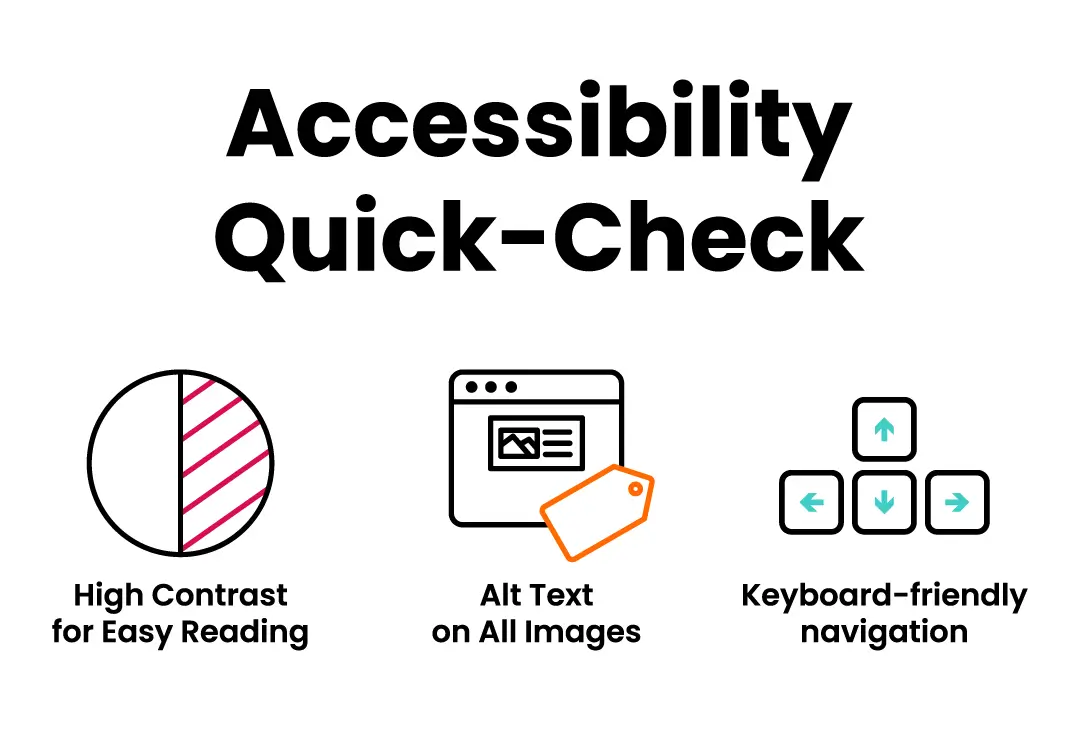
Every visitor deserves a website experience that works for them. That’s why ADA compliance isn’t just about following rules—it’s about inclusivity. Features like proper color contrast, descriptive alt text, and keyboard navigation ensure that everyone, including those with disabilities, can easily use your site. You can read more about accessibility on our ADA Compliance blog.

It Speaks to Real People

Patients don’t want to read pages of medical jargon—they want clear, caring information that helps them understand their options. Writing in a friendly, conversational way helps visitors connect with your practice. Simple calls to action like “Schedule an Appointment” or “Meet Our Team” can guide them naturally toward taking the next step.

Why a Thoughtful Design Means Happier Patients

When your website is simple and reliable, patients have a better experience. Clear layouts and fast load times help them find what they need without confusion, whether they’re booking an appointment or researching a service.

A thoughtful design builds trust by making your site easy to use on any device. It’s fast, mobile-friendly, and optimized so patients can find you when they search for care online. Small details like speed, accessibility, and SEO all work together to create a smoother, more confident patient journey.

How We Design Healthcare Websites That Work

Here’s how we take your healthcare site from outdated to outstanding. Our process is simple, collaborative, and designed to help you connect with patients while building long-term trust online.

  • We Listen: We start by getting to know your practice, your patients, and your goals. Understanding what makes your care unique helps us design a site that truly reflects your values.
  • We Design: Our team builds a modern, authentic look that’s clean, professional, and easy to navigate. Every design choice, from colors to layout, is made to help patients feel confident and comfortable.
  • We Develop: Once your design is approved, we bring it to life. We focus on speed, security, and SEO so your website performs well and is easy for patients to find.
  • We Support: After launch, we don’t disappear. We continue to monitor performance, ensure ADA compliance, and make updates that keep your site working smoothly.

Real Examples of Great Healthcare Design

We’ve worked with healthcare providers and organizations of all kinds, each with their own goals and patient needs. These projects highlight how thoughtful design, clear structure, and accessible content can transform how patients experience care online.

Bluewater Plastic Surgery
Emerald Coast Medical Association
Gulf Coast Podiatry
Gulf Coast Facial Plastics
Capital Medical Society
Brain & Spine Specialist

Let’s Design a Healthcare Website That Feels Like Care

Your patients deserve a website that reflects the quality of care you provide every day. A thoughtful design not only builds trust but also helps people feel comfortable choosing your practice for their health needs.

We’ve helped healthcare organizations create sites that are welcoming, compliant, and built to grow with their goals. Now, let’s do the same for you.

Contact Us today to start building a healthcare website that truly feels like care.

SEO Reputation Management: How Reviews Drive Rankings, Clicks, and Revenue

What Is SEO Reputation Management? (Simple Definition)

SEO reputation management, also called search engine reputation management (SERM), is about shaping what search engines and people see when they look you up online. Beyond keywords and meta tags, it includes signals like star ratings, customer reviews, how you respond to feedback, and whether your business profiles are complete and consistent.

This matters because search engines don’t just want to know what you do, they want to know if you’re credible. A strong online reputation management SEO strategy boosts your local rankings, increases click-through rates, and builds trust with real customers.

  • Reviews and ratings drive “prominence,” a key factor in local SEO.
  • Positive signals improve CTR and on-page conversions.
  • Managing reputation builds trust with both search engines and people.

Do Google Reviews Help SEO? (Short Answer: Yes, Especially for Local)

Yes, Google reviews help SEO, and they matter most when it comes to local search. Search engines see reviews as a trust signal. A steady flow of feedback shows you’re active, credible, and worth showing to more people. The result? Better visibility, more clicks, and ultimately, more customers.

Here are the review signals that move the needle in user reviews and local search optimization:

  • Volume: A consistent stream of new reviews shows you’re relevant right now.
  • Rating: Higher average stars build trust and improve click-through rates.
  • Recency: Fresh reviews tell search engines your business is still active.
  • Owner responses: Speed and tone matter; quick, professional replies boost trust.
  • Keywords in reviews: When customers naturally mention your services, it helps reinforce relevance in search.

Think of reviews as a flywheel: reviews → better visibility → more clicks/calls → more customers → even more reviews. That momentum is exactly what makes reviews and SEO work so well together.

How to Run an SEO Reputation Management Campaign (Step-by-Step)

Running an online reputation management campaign is less about fancy tools and more about building good habits. The goal is to align your reviews, ratings, and responses with your SEO strategy so that your visibility and your reputation grow together. Here’s the SEO reputation management process broken down into simple, repeatable steps.

  1. Audit your current footprint
    • Check your average rating, total reviews, review velocity, and response time.
    • Look at profile completeness on Google Business Profile, Yelp, Facebook, and industry directories.
    • Google “[Your Brand] reviews” and note what shows up on page one.
  2. Claim, fix, and optimize listings
    • Ensure NAP consistency (name, address, phone), categories, services, photos, and hours are correct.
    • Add Q&A, products or services, and appointment links where relevant
    • Use UTM links to track traffic from listings.
  3. Generate reviews every week
    • Ask every happy customer, make it part of your process.
    • If you don’t have a CRM, use QR cards, short links, email signatures, or post-service SMS templates.
    • Never gate reviews or filter only positives; that’s against platform rules.
  4. Respond like a pro
    • Reply within 24–48 hours. Thank positive reviewers.
    • For negative feedback, acknowledge it, move the conversation offline, resolve the issue, then circle back with the outcome.
    • Be mindful of industry rules: for example, avoid PHI in healthcare or confidentiality breaches in legal.
  5. Showcase reviews on your site
    • Add testimonials or user-generated content widgets to high-traffic pages.
    • Create a dedicated Reviews or Testimonials page.
    • Implement Review schema markup to boost visibility in search results.
  6. Monitor and set alerts
    • Use daily or weekly alerts to stay on top of new reviews.
    • Assign someone on your team to “own” responses.
    • Keep a simple log to spot trends over time.
  7. Measure the impact
    • Track KPIs like rating, review velocity, response time, and Google Business Profile views.
    • Measure actions like calls, direction requests, and click-through rates.
    • Watch for branded search lift as your reputation strengthens.

An SEO reputation management campaign works because it builds trust with both search engines and customers. By following these steps, you not only manage SEO client rankings but also build a long-term reputation management strategy that drives revenue.

Beyond Local: Search Engine Reputation Management for Your Brand SERP

SEO reputation management is not just about your Google Business Profile. When someone types your brand name into Google, the entire first page of results becomes your digital storefront. That means search engine reputation management has to extend beyond local listings to make sure you control the narrative at scale.

Own more of page one for “[Brand]”

  • Optimize your website, Google Business Profile, social profiles, directories, YouTube channel, and press mentions.
  • Publish a Reviews hub and a Customer Support page to capture queries like “[Brand] reviews” or “[Brand] complaints.”

Push positive assets, not spin

  • Share fresh case studies, thought leadership pieces, and community stories that build authority.
  • Maintain consistent brand profiles and knowledge panels so search engines can confidently showcase the right information.

Done right, Google search reputation management is less about hiding the negatives and more about making sure your best, most authentic content earns its place on page one.

Quick Wins & Pro Tips

  • Add new photos, services, and posts in Google Business Profile every month.
  • Include a short review request script at checkout or right after service.
  • Track how many review requests actually turn into reviews.
  • Create a simple response library so staff can reply quickly and consistently.
  • Block off a weekly “review hour” on the calendar to keep momentum going.

What If You Don’t Have a CRM? (No-Excuses Toolkit)

  • Print a QR code on receipts, vans, or at the front desk.
  • Add a one-click shortlink to invoices and email signatures.
  • Keep a simple spreadsheet to track who was asked and who actually left a review.
  • Create a monthly leaderboard to encourage staff participation.

Even without automation, these small steps keep reviews flowing and your SEO reputation management strategy moving forward.

How We Help

Reputation management doesn’t have to be overwhelming. Our process is built to take the heavy lifting off your plate and keep results consistent. We start with a reputation audit, clean up and optimize your listings, set up a simple review engine, manage responses, and provide clear reporting along the way. Get a Free Reputation Snapshot to see where you stand today and how we can help you build a stronger online presence.

Why LinkedIn is the Most Underrated Tool in Your Marketing Stack

The Business Case for LinkedIn Marketing

LinkedIn isn’t just a place to swap résumés anymore. It has evolved into a full-scale business growth channel, and building a clear LinkedIn marketing strategy helps professionals, decision-makers, and B2B buyers learn, connect, and make deals. Unlike platforms where people are mostly scrolling for entertainment, LinkedIn users come with a higher intent. They’re already in a business mindset, which makes your content and ads feel more credible, more relevant, and far more likely to spark meaningful conversations that translate into leads and partnerships.

Building a Social Funnel on LinkedIn

LinkedIn works best when you treat it like a funnel, with different types of posts feeding each stage of the journey:

  • Top of Funnel: Share thought leadership posts, industry news, or quick bite-sized tips. Example: a two-sentence take on a trending headline or a graphic with a “3 tips for busy marketers” list. These spark awareness and start conversations.
  • Middle of Funnel: Nurture trust with case studies, employee spotlights, or a short video showing how you solved a client challenge. Repurpose blog content here to give your audience deeper value.
  • Bottom of Funnel: Drive action with event promos, gated resources, or demo invitations. Example: “Join our upcoming LinkedIn Live to see how X company cut costs by 30%.” These posts convert interest into leads.

The key is consistency. LinkedIn rewards businesses that show up regularly, not those who post once and disappear. That is why having a social media marketing strategy in place is essential for keeping content flowing and engagement steady.

LinkedIn Advertising Options That Deliver

LinkedIn ads often come with a higher price tag than Facebook or Instagram, but the value is in the targeting. Instead of blasting ads to a broad audience, you can get incredibly precise, down to job title, seniority, skills, company size, and even individual industries. That means your budget isn’t wasted on impressions that will never convert.

Here are the ad formats that matter most:

  • Sponsored Content
    Native posts that appear directly in a user’s feed. Best for brand awareness and thought leadership campaigns where you want to spark engagement.
  • InMail / Message Ads
    Delivered straight to a user’s inbox. Ideal for lead generation, event invites, or highly targeted offers. These work especially well when paired with a clear, compelling CTA.
  • Dynamic & Text Ads
    Smaller placements that appear on the side of LinkedIn. They don’t grab as much attention but can be effective in reinforcing brand presence or retargeting warm audiences.

The real advantage is how well these options layer together. A Sponsored Content campaign can introduce your brand, while InMail closes the loop with a direct offer. When you use LinkedIn’s targeting superpowers strategically, even a modest ad spend can deliver high-quality leads.

What Types of Businesses Thrive on LinkedIn

While any business can use LinkedIn, some industries naturally see more success because the platform attracts professionals and decision-makers. Here are the groups that tend to thrive:

Industry Type Why It Works on LinkedIn
B2B Companies (SaaS, agencies, consultants) LinkedIn is built for business conversations, making it easier to connect with buyers and decision-makers.
Professional Services (recruiters, accountants, law firms) Perfect for networking, showcasing expertise, and building trust through thought leadership.
Niche B2C Brands (luxury goods, education, career-related) Works best when targeting affluent or career-driven audiences who are already in “professional mode.”
Nonprofits, Associations, Higher Ed Strong for thought leadership, awareness campaigns, and connecting with donors, alumni, or members.

If your audience lives on LinkedIn, you’ll get more than clicks. You’ll get conversations that can turn into clients, partnerships, or long-term advocates.

LinkedIn Features That Go Beyond Posting

LinkedIn has steadily built tools that are designed for businesses and professionals, not just casual social sharing. These features give you more ways to reach the right people, build authority, and keep your brand visible without relying only on ads:

  • LinkedIn Newsletters
    Publish recurring content directly on the platform. Subscribers are notified every time you post, which keeps your thought leadership in front of your audience without fighting algorithms.
  • Events and LinkedIn Live
    Host webinars, panel discussions, or live Q&A sessions. These tools make it simple to engage with your audience in real time and build relationships through interaction.
  • Company Page Features
    Build out service pages, add calls-to-action, and tap into detailed analytics. Encourage employees to engage with company updates to multiply reach through their networks.
  • Showcase Pages
    Create dedicated spaces under your company profile for specific products, initiatives, or audiences. This is especially useful for larger brands with multiple offerings.
  • Creator Mode
    Individuals can switch on Creator Mode to access tools like newsletters, Live, and expanded profile features. It is a strong option for leaders who want to grow personal credibility alongside company branding.
  • Analytics and Insights
    Track content performance, follower growth, and audience demographics. LinkedIn provides deeper professional data than other platforms, which makes it easier to refine strategy.

These features make LinkedIn a platform that is tailored for professional growth and brand credibility. Instead of chasing likes, you are building authority and long-term visibility.

Pro Tips to Maximize LinkedIn Marketing ROI

Getting results on LinkedIn is less about chasing likes and more about making strategic choices. Encourage employees to engage with company content to expand reach through their networks, and look for ways to repurpose existing material like blogs or case studies into posts, carousels, or short videos to stay consistent without reinventing the wheel. Strong content marketing makes it easier to create assets that work well across LinkedIn. Measure success by tracking clicks, leads, and conversations rather than vanity metrics, and balance organic posting with paid campaigns by putting ad spend behind the content that already performs well. 

With a few disciplined habits, LinkedIn shifts from being a “nice-to-have” platform into a steady growth driver.

Bringing It All Together: Why LinkedIn Belongs in Your Strategy

When you connect the dots between the funnel, advertising options, and unique platform features, LinkedIn turns into a true growth engine for businesses. It remains one of the most underrated tools in digital marketing, offering credibility, targeting power, and professional reach that other platforms can’t match. If you are ready to explore how LinkedIn can fit into your marketing strategy, we can help. 
From building your content funnel to running precise ad campaigns, we make sure LinkedIn becomes a measurable driver of growth. Let’s talk about your LinkedIn strategy.

What Is AI SEO? How to Optimize for AI Search in 2025

AI SEO is about making sure your business shows up when people ask questions in AI-driven search engines like Google’s Search Generative Experience (SGE), Bing Copilot, Perplexity, or ChatGPT. Instead of only optimizing for “blue links,” you’re optimizing to be named, cited, and trusted inside the answers these systems generate.

If your brand isn’t visible there, you risk being skipped over entirely, even if you still rank well in traditional Google results.

And it’s not a fringe behavior anymore. Nearly 3 in 4 Americans now use AI tools for search (AP-NORC), and most describe them as faster, more conversational, and more curated than the old “10 blue links.” From recipes to product comparisons to how-to guides, people are turning to AI because it feels like asking an expert, not sifting through pages of links.

This is why AI SEO matters: your customers are searching differently, and your visibility now depends on whether AI trusts you enough to include your brand in the answer.

Why Traditional Rankings Aren’t Enough Anymore

For years, SEO has been about rankings: get to page one, climb to the top, and you’ll win the click. But AI search is rewriting those rules.

When someone asks Bing Copilot, Perplexity, or ChatGPT a question, the answer they get isn’t a list of links. It’s a synthesized summary pulled from trusted sources, often with a handful of citations. That means two things:

  • You could be ranking #1 in search results, but not mentioned in the AI-generated overview at all.
  • Or, you could be a smaller brand that doesn’t rank traditionally, but if AI sees you as credible, you get the mention anyway.

In other words, AI SEO is less about positions and more about mentions. The game isn’t only about where you rank, but whether you’re part of the answer.

Quick Stat: 71.5% of people now use AI in search, with 14% doing so daily (Higher Visibility).

That stat says it all: AI-driven answers are no longer optional real estate. They’re where your customers already are.

What Signals Do AI Search Engines Look For?

AI-driven search engines don’t “rank” pages the way Google’s traditional algorithm does. Instead, they pull from sources they trust most to generate answers. That means the signals that matter are less about exact-match keywords and more about credibility, clarity, and coverage.

Authority & Trust (E-E-A-T)

Google, Bing, and AI search engines all lean heavily on experience, expertise, authoritativeness, and trustworthiness (E-E-A-T). If your brand consistently demonstrates expertise (through blog content, author bios, case studies, or third-party recognition), you’re far more likely to be cited as a reliable source.

Think of it this way: AI won’t risk quoting a random site. It wants to sound authoritative, so it leans on the most credible voices in the room.

Mentions Across the Web

One of the strongest signals for AI search visibility is how often your brand gets mentioned — not just on your own site, but across the broader web. News articles, press releases, customer reviews, podcast appearances, and even social media posts all contribute.

If AI sees your name consistently in conversations around a topic, it’s more likely to include you when generating an answer. In other words, citations aren’t just nice PR wins; they’re a core AI search optimization lever.

Entity Clarity with Schema

AI search engines think in entities (people, companies, products, places), not just strings of keywords. Using structured data like schema markup helps define your brand as a clear, recognized entity. This can mean marking up your business details, FAQs, product data, or reviews so machines know exactly who you are and what you do.

The clearer the signal, the harder it is for AI to confuse you with someone else.

Content AI Can Read (FAQs, Lists, Clear Answers)

Unlike traditional SEO, which rewarded long, keyword-rich posts, AI systems prefer content that’s structured and easy to parse. FAQs, step-by-step lists, and short direct answers are more likely to be pulled into AI responses because they’re straightforward and machine-friendly.

If you want to appear in AI summaries, give the AI content it can digest quickly, not walls of jargon or fluff.

How to Optimize for AI Searches (Step-by-Step)

AI SEO can sound overwhelming, but it comes down to building visibility in the places AI pulls from most. Here’s a practical roadmap:

  1. Audit Your Mentions
    Search for your brand in Bing Copilot, Perplexity, and Google Gemini. See if you’re cited in AI responses. If not, make note of which competitors are showing up.
  2. Fix Schema & Business Profiles
    Clean up your schema markup (organization, FAQ, reviews). Update Google Business Profile, Bing Places, and industry directories. The more consistent your presence, the easier it is for AI to recognize and cite you.
  3. Generate Mentions
    Earn citations through reviews, press releases, directories, Reddit, and Quora discussions. Anywhere your brand is discussed, AI can potentially pick it up as a trust signal.
  4. Add FAQs & Q&A Content
    Publish FAQ pages and embed Q&A sections in blogs and product pages. Consider adding an llms.txt file to guide how AI scrapers interpret your content.
  5. Go Multimodal
    AI isn’t just text-based anymore. Use alt text, captions, and transcripts to make images, video, and audio searchable and accessible. These help AI understand your content across formats.
  6. Use Natural Keywords
    Work in phrases like “optimize website for AI search” and “SEO for AI search” where they fit naturally. These queries are rising fast and help align your content with how real users are asking questions.

AI SEO vs. Traditional SEO (And Why You Need Both)

It’s tempting to frame AI SEO as “the new SEO,” but that’s not quite right. The truth is: AI SEO and traditional SEO work best together. One doesn’t replace the other — they layer.

Here’s how they complement each other:

  • Local Search → Reviews, GBP, and Directories
    If you’re a local business, traditional SEO ensures your Google Business Profile and Yelp listings are optimized. AI SEO builds on that by emphasizing reviews, ratings, and consistent mentions across local directories, the signals AI uses to recommend you when users ask “What’s the best [business type] near me?”
  • National Search → E-E-A-T, Schema, and PR Mentions
    At the broader level, traditional SEO leans on technical optimization, content, and backlinks. AI SEO takes those same elements but shifts the focus: schema for clear entity recognition, E-E-A-T for credibility, and PR mentions for wider authority.

This layered approach is sometimes called Answer Engine Optimization (AEO) because instead of only optimizing for search engines, you’re optimizing to be part of AI-driven answers.

The bottom line? Ranking is still important, but it’s no longer the whole picture. To future-proof your visibility, you need both SEO for rankings and AI SEO for mentions working in tandem.

Do You Need AI SEO Services?

If you’ve been asking whether your brand is showing up in AI search or worried you’re falling behind, this is where an AI SEO agency can help.

The right AI SEO services go beyond rankings. They include:

  • Monitoring where (and if) your brand is being cited in tools like Bing Copilot, Perplexity, and Google Gemini.
  • Optimization of schema, business profiles, reviews, and FAQs so AI systems recognize and trust your brand.
  • Growth through PR mentions, directory listings, and community visibility (Reddit, Quora, industry forums).

It’s about keeping your business visible not just today, but in the way people are searching tomorrow.

Final Thoughts: Future-Proofing with AI Search Optimization

AI search isn’t a passing trend. It’s already how millions of people get answers. The good news? It’s not too late. Brands that act now can secure visibility while competitors are still figuring it out.

Early movers win. And with the right strategy, you don’t just adapt to AI search, you thrive in it.

Google Tag Manager Access: How to Grant and Request Permissions

Managing website tracking and analytics can get complicated, but Google Tag Manager (GTM) makes it easier. Whether you’re setting up Google Analytics, tracking ad conversions, or integrating third-party tools, GTM lets you add and update tracking tags—all without touching your site’s code.

But what if you need to grant someone access to Google Tag Manager or request access yourself? Whether you’re a business owner working with an agency, an SEO specialist needing GTM access, or a developer setting up advanced tracking, understanding GTM access levels and how to add users properly is key to keeping your data organized and secure. Let’s dive in!


What is Google Tag Manager & Why Is It Important?

Tracking user behavior, ad performance, and website analytics is essential for making informed business decisions. Instead of manually adding tracking codes to your site, Google Tag Manager (GTM) makes the process easier—allowing you to add, update, and manage tracking scripts without having to crack into your site’s code.

How GTM Works

Think of GTM as a container that holds all your tracking tags in one place. Instead of embedding multiple scripts—like Google Analytics, Facebook Pixel, or LinkedIn Insight Tag—directly into your website, everything is managed through GTM’s intuitive dashboard. This keeps your site organized and makes updates seamless.

Why Businesses Use GTM

  • Less Dependence on Developers – No need to edit site code for every tracking update.
  • Better Site Performance – Loads tags efficiently without slowing down pages.
  • More Accurate Tracking – Reduces errors by keeping all tracking scripts in one place.
  • Easy Integrations – Works with Google Ads, Meta (Facebook) Pixel, LinkedIn Insight, and more.

By simplifying tag management, GTM helps businesses improve tracking accuracy, optimize performance, and stay agile with their marketing efforts.


Who Needs Access & Why?

Tag management isn’t just for developers—it plays a big role in marketing, analytics, and website tracking. That’s why different teams and partners often need GTM access to do their jobs effectively:

  • Marketers & Advertisers – Set up ad tracking, remarketing, and conversion goals.
  • SEO Specialists – Implement schema markup and monitor user behavior.
  • Developers – Configure advanced triggers and troubleshoot tracking issues.
  • Agencies & Freelancers – Manage campaigns and optimize tracking strategies.

Understanding Google Tag Manager Access Levels

Not everyone needs full control, which is why GTM access levels let you assign permissions based on what a user actually needs to do. This keeps your data secure while allowing for smooth collaboration.

GTM User Roles & Permissions

  • Read – Can view settings but can’t make any changes.
  • Edit – Can create and modify tags, triggers, and variables but can’t publish.
  • Approve – Can edit and approve changes but can’t push them live.
  • Publish – Has full control, including the ability to publish updates to the site.

Choosing the right access level ensures team members and partners have the permissions they need, without adding unnecessary risk.


How to Grant Access to Google Tag Manager

Need to give someone GTM access? The good news is that adding users is quick and easy. Here’s how to do it:

Step-by-Step: Adding a User to Google Tag Manager

1. Log in to Google Tag Manager at tagmanager.google.com. You’ll see a list of the accounts you manage.

2. Find the account you want to share access to and click the cog icon to the right. This brings up the Account Admin page.

3. On the Account Admin page, click User Management on the left.

4. Under User Management, click the blue plus icon and choose Add User from the dropdown.

5. Enter the user’s Google email address.

6. Choose the right access level (Read, Edit, Approve, or Publish).

7. Click Invite to send the request.

Once they accept, they’ll have access based on the permissions you assigned.


How to Request Access to Google Tag Manager

Need access to a GTM container but don’t have it yet? Here’s how to ask the right person and get the right permissions.

Who to Ask for Access

The right contact depends on the company or website you’re working with. Typically, you should reach out to:

  • The website owner or admin
  • The marketing team managing analytics
  • The IT department or developer handling website tracking

What to Include in Your Request

To make the process smooth, be clear about what you need:

  • Your Google email address (work email preferred)
  • The reason for your request (e.g., setting up tracking, managing tags)
  • The level of access required (Read, Edit, Approve, or Publish)

The more details you provide upfront, the faster you’ll get access. And if you’re not sure who to ask, checking with the marketing or IT team is usually a good place to start.


Troubleshooting Common GTM Access Issues

Running into problems with GTM access? Here are some quick fixes for the most common issues:

  • Didn’t get the invitation email? – Check your spam folder first. If it’s not there, ask the person who sent the invite to double-check the email address and try again.
  • Can’t see the container? – Make sure you’re logged into the right Google account. It happens more often than you’d think!
  • Permissions not working? – If you can’t make edits or publish changes, your access level might not be set correctly. Reach out to the admin to confirm.

Still stuck? The best next step is to contact the Google Tag Manager account owner or admin for help.


Make Tracking Simple & Collaboration Seamless

Collecting data is one thing—keeping it organized and manageable is another, and that’s why businesses use Google Tag Manager. Not only does it centralize all your tracking in one place, but adding a user is quick and easy, making collaboration seamless without compromising control.

When your tracking is set up correctly and your team has the right access, everything runs more smoothly—freeing you up to focus on the bigger picture. At Curiosity Marketing Group, we help businesses turn data into actionable insights and use it to drive real marketing results. Need expert guidance? Don’t hesitate to reach out. We’re here to help!