


You Click “Accept” Every Day. Should Your Site Be Asking the Same Question?
You click “Accept Cookies” dozens of times a week. On news sites, shopping sites, even the site where you order lunch. At some point, most business owners start wondering: does my website need one of those too?
The short answer is that it depends on a few things, and probably not in the way you’d expect. The rules aren’t as clear-cut as you’ve been led to believe, and what applies to a Fortune 500 company likely doesn’t apply to your business the same way.
But here’s what we know: the landscape is shifting. And if you’ve been through the ADA compliance wave over the last few years, this might feel familiar.
What Is a Cookie Consent Banner, and Why Is Everyone Talking About It?
A cookie consent banner is the pop-up or bar you see on websites asking whether you’ll allow tracking. Behind the scenes, most business websites use tools like Google Analytics, Facebook Pixel, embedded videos, and advertising tags to understand how visitors interact with their site. Those tools use cookies, which are small files stored in your browser, to collect that data.
The conversation around cookie consent has exploded because privacy regulations are expanding. In Europe, strict opt-in laws have required these banners for years. In the U.S., the rules work differently, but they’re catching up fast.
What Privacy Laws Actually Exist in the U.S. Right Now?
There is no single federal cookie law in the United States. Instead, 20 states have passed their own comprehensive privacy laws as of 2026. These include California (CCPA/CPRA), Virginia, Colorado, Connecticut, Texas, and others.
Here’s what matters: U.S. state privacy laws use an opt-out model, not the opt-in model you see in Europe. That means your website can load cookies by default, but you need to give visitors a clear way to opt out of data collection used for targeted advertising or the sale of personal information.
If you’re a business in Florida (and many of our clients are), this is especially relevant. Florida’s Security of Communications Act was originally written to govern the interception of communications, not to regulate website cookies or tracking pixels. But that hasn’t stopped plaintiffs’ attorneys from testing whether it applies to modern tracking technologies. Florida doesn’t currently have a broad cookie opt-in requirement, but the litigation risk is real and growing. Similar wiretapping statutes in California and other states are already producing settlements in the millions.
If that sounds like a gray area being exploited through litigation, you’re paying attention.
Does This Actually Apply to My Small Business?
Here’s where most business owners can take a breath.
Most state privacy laws have threshold triggers before they apply to your business. The most common: processing data from 100,000 or more consumers annually, or generating $25 million or more in revenue (California). “Consumers” in this context means anyone whose data you touch, which includes website visitors, not just paying customers.
If you’re a local business with a few hundred site visitors per day, you’re almost certainly below those thresholds.
But that doesn’t mean the risk is zero. Here’s why:
- Texas has no revenue threshold. If you process data from enough Texas residents, you could be in scope regardless of size.
- Wiretapping claims (like those under Florida’s statute) don’t follow the same thresholds as privacy laws. A single plaintiff can file.
- The trend is moving in one direction. Thresholds are getting lower, not higher, as new states pass laws.
Sound familiar? It should. A few years ago, ADA website accessibility was a gray area for most private businesses. Then the lawsuits started, and suddenly everyone needed a compliance plan. We’re watching the same pattern develop around website tracking and data privacy.
What’s Probably Running on Your Website Right Now
Most business owners don’t know exactly what’s collecting data on their site. Here are the usual suspects:
- Google Analytics tracks every visitor, page view, session, and traffic source
- Facebook/Meta Pixel tracks actions visitors take so you can retarget them with ads
- Embedded YouTube videos can set cookies even if a visitor doesn’t press play
- Contact form plugins may store data in third-party systems
- Chat widgets often set tracking cookies for user identification
- Google Maps embeds set cookies through the iframe
If your site uses any combination of these (and almost every business site does), your website is collecting visitor data whether you’ve thought about it or not.
What a Cookie Consent Banner Actually Does (and What It Doesn’t)
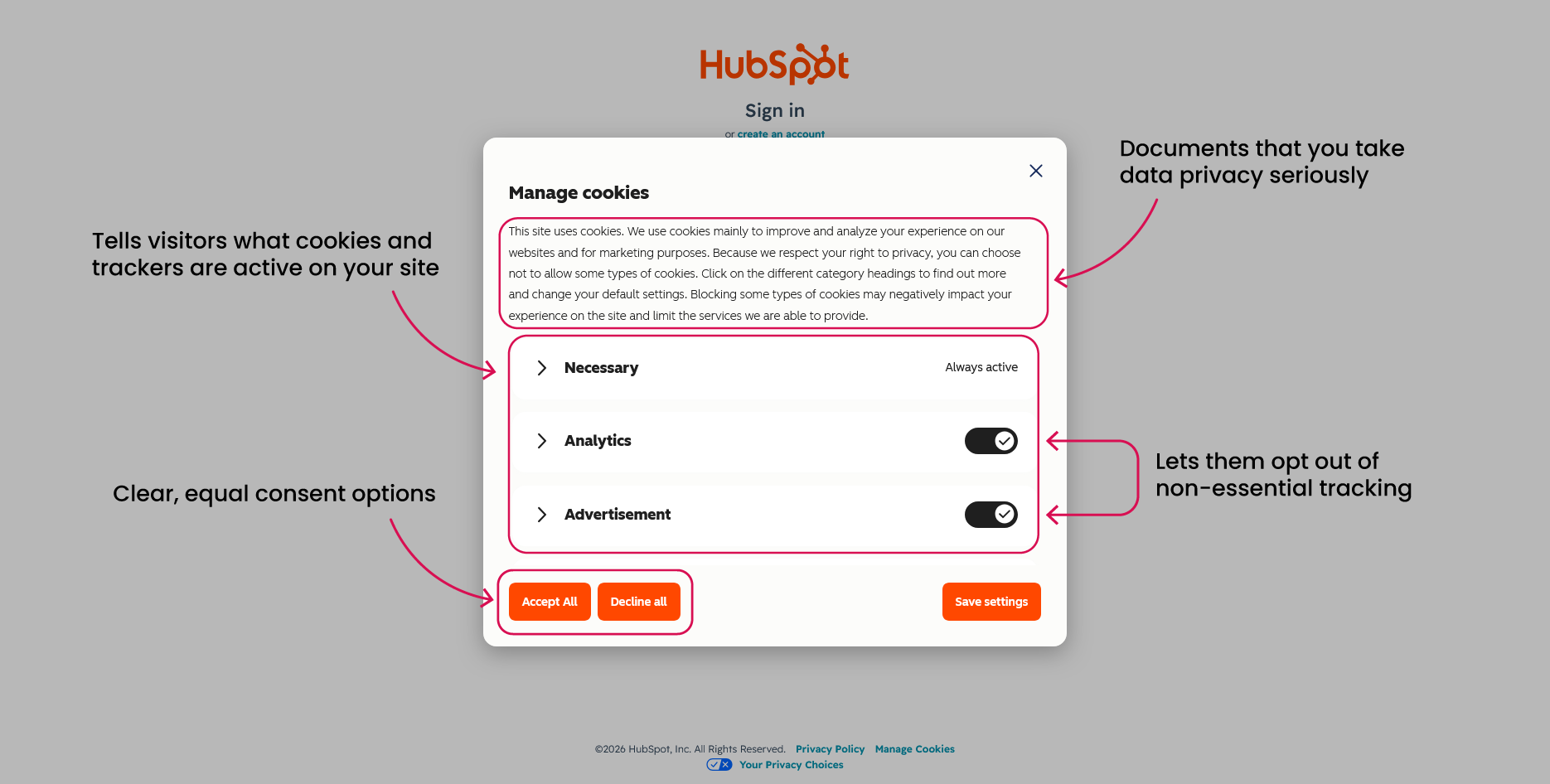
A cookie consent banner gives visitors two things: disclosure (“here’s what we’re collecting”) and control (“here’s how to opt out”).
What it doesn’t do is make you automatically compliant with every law or immune to lawsuits. It’s one layer of protection. Think of it like a lock on your door. It won’t stop a determined intruder, but not having one makes you an easier target.
A properly configured consent banner:
- Tells visitors what cookies and trackers are active on your site
- Lets them opt out of non-essential tracking
- Honors browser-based privacy signals like Global Privacy Control
- Documents that you take data privacy seriously
Should You Add One Even If You’re Not Legally Required To?
We think yes, and here’s the reasoning.
The cost of implementing a basic cookie consent solution is minimal. Platforms like Cookiebot, CookieYes, and Termly cost between $5 and $15 per month for most small business sites, and some offer free tiers for smaller sites.
Compare that to the cost of defending even a frivolous lawsuit, or the reputational hit of being named in a privacy complaint.
This is the same approach we recommended with ADA compliance. The question was never “does the law technically require me to do this today?” The question was “do I want to be the business that gets caught without it when enforcement catches up?”
A consent banner shows visitors, search engines, and potential plaintiffs that you take privacy seriously. It’s a small step that removes you from the easy-target list.
How to Know Where You Stand
If you’re not sure what tracking tools are running on your site, or whether your current setup puts you at risk, the simplest starting point is a review.
We can scan your website, identify what’s collecting data, and walk you through your options based on your specific situation. No two businesses are the same, and what makes sense for one may not make sense for another.
Want us to take a look? Request a free cookie review, and we’ll help you determine what, if anything, needs to change.
Frequently Asked Questions
Florida does not currently have a comprehensive privacy law requiring cookie consent. However, Florida’s Security of Communications Act is being tested in litigation around website tracking. A consent banner is a low-cost precaution that helps demonstrate good faith.
No. GDPR is the European Union’s regulation, which requires opt-in consent before any tracking. U.S. laws work differently. Most use an opt-out model, meaning tracking can start by default, but visitors must have a clear way to say no.
A privacy policy is a document that explains what data you collect and how you use it. A cookie consent banner is an interactive tool that gives visitors real-time control over tracking. You likely need both, but they serve different purposes.
Our initial review is free. We’ll scan your site, show you what’s collecting data, and walk you through your options. If you decide to move forward with implementation, we’ll scope that based on your specific situation.
You can, but a banner that doesn’t actually block cookies until consent is given (or honor opt-out requests) isn’t doing much. Proper implementation requires the banner to integrate with your site’s tracking scripts.